In the final exhibition of the City and Lit Fine Art course 2012, I exhibited two videos. Ideas for both have appeared earlier in the blog. Picasso is quoted as saying "Bad artists copy and good artists steal". I am hoping that I have stolen a lot from William Kentridge, his work and approach has certainly been a great inspiration. What these videos demonstrate (I hope) is his belief in the malleability of charcoal drawing and the potential for narrative. I have brought some of my media skills to bear in the editing, but tried to stay true to the tentative and rough nature of the actual drawing.
The first is An animation made up of charcoal and pastel drawings and sculptured polymer clay. It shows three different representations of hands each of which explore the theme of mortality. In the first a hand floats below the surface in a river gradually disappearing from view. In the second the bones of a hand are revealed in the sand and in the final section an X Ray of a hand illustrates the effect of a dislocated finger.
The second is a series of animated charcoal and pastel drawings that tell the story of three of the less hopeful aspects of my father's inheritance. The first is a fear of confined spaces that he experienced most vividly when digging an escape tunnel in the Italy in 1942. The second a loss of hearing which in my father's case was largely caused by the effect of artillery fire (he was a Gunner). And finally a surprising heart attack, which I am hoping to avoid.
Tuesday, 24 July 2012


Tuesday, 10 July 2012
What has been happening since January?
It is not wholly insignificant that I have not written anything on this blog since January 30th. Of course it is partly laziness, but rather more it is a reflection of my loss of direction and decline in morale. The last few posts describe my tentative work using the copy stand to animate my charcoal drawings and experiment with the sculpted bones. It did excite me for a while, and yet, reading the blogs I already detect an uncertainty. I am clearly worried about letting my film making knowledge with its emphasis on carefully structured narrative and 'looking slick', intrude into my much less confident and certainly non-professional art work.
I also went through a bad case of the "so what"s. It is the nature of the City Lit Fine Art Course that you are left to your own devices. The tutors do their best and I had a few good tutorials that gave me hope, but generally there is a little support to see you past the nihilism that overcomes you. And perhaps, nor should there be. If you have any aspirations to becoming an artist: it seems obvious that you need to get yourself through to a place where it does seem worthwhile.
At some point in the spring when I was feeling particularly down, I had a tutorial with Liz Ellis. She is very supportive (background as a mental health nurse!) and picked up on my interest in William Kentridge. She lent me a substantial catalogue from his big London show of five years ago. It was a hugely stimulating. Not only supporting my interest in his animation, but also some excellent material on his approach to art and making art. One particular quote stood out for me and had a significant impact on kick starting me into a more productive phase:
I also went through a bad case of the "so what"s. It is the nature of the City Lit Fine Art Course that you are left to your own devices. The tutors do their best and I had a few good tutorials that gave me hope, but generally there is a little support to see you past the nihilism that overcomes you. And perhaps, nor should there be. If you have any aspirations to becoming an artist: it seems obvious that you need to get yourself through to a place where it does seem worthwhile.
At some point in the spring when I was feeling particularly down, I had a tutorial with Liz Ellis. She is very supportive (background as a mental health nurse!) and picked up on my interest in William Kentridge. She lent me a substantial catalogue from his big London show of five years ago. It was a hugely stimulating. Not only supporting my interest in his animation, but also some excellent material on his approach to art and making art. One particular quote stood out for me and had a significant impact on kick starting me into a more productive phase:
The
pure light of inspiration, for me, is always to be treated with caution.
Things
that leap out as ‘good ideas’ are often best left
at that. It is in the physical act of their coming into being, and in
the form they finally achieve that they have to show their worth, and often
things that start rather in the alleys and sluices of the mind, hold their own
in the end.
William
Kentridge Fortuna: Neither programme nor chance in the
making of images 1994
I had been spending far too much time on what I thought were 'good ideas': only to have them crumble under my clumsy hand. Kentridge told me to abandon that level of planning and so called creative excitement and instead get on and TRY stuff. Let its potential demonstrate itself in the doing: not in the anticipation.
Now I am two weeks away from the exhibition and about to go to the last session. I will promote my blog at the exhibition so the next few posts will be by way of description and explanation of what I ended up doing and , perhaps more importantly, valuing my work over the last two years.
Monday, 30 January 2012
Xray Hands and Dislocated Finger
A further attempt to create stop frame video around the theme of the bones in my hand. In this case I wanted to replicate the Xray view that had started this all off. In particular the Xray of my dislocated finger. As before I wanted the video to be as much about its making as about its effect. There are glimpses of the drawing hand to emphasise the connection I am trying to make between my hand as the facilitating element of my art and the art itself.
I came across the granular effect by mistake. I wanted to roughen the edges a bit and this filter seemed to do just that. In addition it added some very interesting textures to the charcoal image. In some ways the most interesting part of this video. My son feels that the Philip Glass music is overly loaded with meaning and undermines the ambiguity of the images. I suspect he is right, but it is hard to resist the momentum and layered quality of the piece.
I am still not sure whether this leading anywhere. I am not convinced it will play a part in the final show, although I will continue to experiment and collect pieces as I think it is possible that I could pull fragments of many of these together into something that would provide a meaningful backdrop to the the 2D work I am trying to do!
I came across the granular effect by mistake. I wanted to roughen the edges a bit and this filter seemed to do just that. In addition it added some very interesting textures to the charcoal image. In some ways the most interesting part of this video. My son feels that the Philip Glass music is overly loaded with meaning and undermines the ambiguity of the images. I suspect he is right, but it is hard to resist the momentum and layered quality of the piece.
I am still not sure whether this leading anywhere. I am not convinced it will play a part in the final show, although I will continue to experiment and collect pieces as I think it is possible that I could pull fragments of many of these together into something that would provide a meaningful backdrop to the the 2D work I am trying to do!
Tuesday, 24 January 2012
Hand Bones and Sand v1
I have continued to work on ideas for the stop frame animations based on my hand the bones I made last term. In this short piece I have introduced the idea of the sand and archaeology as a way of exploring the theme of mortality. Some of the sequences work well whilst in others the pacing is laborious and loses momentum. My plan is to make a series of these and then work them together into a longer sustained piece that will complement my other art work on the hand:
Back to the portraits
After a very fallow Christmas and New Year period when I found it really difficult to engage with art at all, I was dreading the the first portrait class of the year. I was fearful that any gains I may have made in the first term would have been washed away by the festive miasma. In fact it wasn't quite as bad and I did appear to have retained some of the lessons learnt, although there was the usual pain and anguish before producing one half decent drawing:
 This was actually a half way reasonable likeness although I was in the end dispirited by the fact that my charcoal drawings are starting to all look the same. I apply the same techniques, go through the same tortuous process and end up with a very similar looking picture. So I want to address the question of how to get a fresher look, something a little more risky perhaps: less formulaic. I intend to broach this with James and perhaps try some other media as well.
In the meantime, I was motivated to try some more portraits at home and saw a display of Lee Jeffries fine portraits of homeless men and woman. I have since started to do charcoal sketches of one of these a day. So far it seems to be a useful exercise. Each of his characters are full of rich and quirky detail (he also jacks up the contrast which helps). Here are the first three:


In the meantime, I was motivated to try some more portraits at home and saw a display of Lee Jeffries fine portraits of homeless men and woman. I have since started to do charcoal sketches of one of these a day. So far it seems to be a useful exercise. Each of his characters are full of rich and quirky detail (he also jacks up the contrast which helps). Here are the first three:


Monday, 16 January 2012
Animation Part 2: Hand and bones
For my second attempt at an animation piece I have brought in the sculpted bones and worked up a short piece that tries to link the bones and the hand. There are a few (gratuitous?) special effects to emphasise the transitions. I have also added a little low key music.
Although I get some satisfaction from the superficial appeal of this short piece, it has rather made me wonder whether this is a productive direction to go in. I feel it is a little too obvious and 'on the nose' as a script writer may say. I am not sure whether this is a medium that will allow for a 'malleable' piece of art. Perhaps I am fighting the film maker in me again.
I will persevere with a few more ideas and then perhaps think about how I could pull them together in a single piece. Nevertheless I can only explore this work in my own time with the copy stand at home, and I find I am rather daunted by the prospect of another day in our rather cramped studio as I am very unsure where to take my 2D work.
Although I get some satisfaction from the superficial appeal of this short piece, it has rather made me wonder whether this is a productive direction to go in. I feel it is a little too obvious and 'on the nose' as a script writer may say. I am not sure whether this is a medium that will allow for a 'malleable' piece of art. Perhaps I am fighting the film maker in me again.
I will persevere with a few more ideas and then perhaps think about how I could pull them together in a single piece. Nevertheless I can only explore this work in my own time with the copy stand at home, and I find I am rather daunted by the prospect of another day in our rather cramped studio as I am very unsure where to take my 2D work.
Friday, 13 January 2012
Animation Part 1: my drawing hand
During the first year my nephew Jesse Ash , an accomplished artist and art theorist, introduced me to the work of William Kentridge, the South African artist who spent some time working on sustained animated charcoal drawings. Jesse felt that it combined my enthusiasm for charcoal drawings (that had been instilled largely by Tony Hull's first session on this course) with my background as a film maker. I have been resisting any connection with that part of my creative experience on the grounds that I was not much taken by video art and I felt that my professional sensibilities would get in the way of anything authentic in the way of art. However, the Kentridge videos did get me excited and I had always intended to give it a try.
Following my investment in my hand, its injuries, its bones and, I suppose, its eventual mortality: I thought that I wanted to explore the role my hand plays in my art in general and then, in particular, its role in my struggle to draw and make art. So, it seemed that a charcoal animation might be the way to develop this idea.
I knew enough about the process to know that it is very hard to do without at least some sort of solid stand and lighting and to my intense surprise, I found myself locating and buying a professional copy stand on Ebay, closing the deal on a very reasonable £75. I decided that I was going to restrict myself to still images on a stills camera, rather than use a video camera. These images would be edited in a very basic Microsoft editing programme Windows Live Movie Maker.
This was my first effort:
The wooden hand was one of those artist models that I had been using to help me draw: (actually they don't help much as they don't really resemble a human hand at all, more the hand of rather poorly constructed robot!).The struggle to draw it was all mine! I resisted the temptation to 'tidy it up', it felt like the odd appearance of the drawing hand itself had a useful foregrounding effect. It does not look like the work of a film maker, and that feels right at this stage.
Following my investment in my hand, its injuries, its bones and, I suppose, its eventual mortality: I thought that I wanted to explore the role my hand plays in my art in general and then, in particular, its role in my struggle to draw and make art. So, it seemed that a charcoal animation might be the way to develop this idea.
I knew enough about the process to know that it is very hard to do without at least some sort of solid stand and lighting and to my intense surprise, I found myself locating and buying a professional copy stand on Ebay, closing the deal on a very reasonable £75. I decided that I was going to restrict myself to still images on a stills camera, rather than use a video camera. These images would be edited in a very basic Microsoft editing programme Windows Live Movie Maker.
This was my first effort:
The wooden hand was one of those artist models that I had been using to help me draw: (actually they don't help much as they don't really resemble a human hand at all, more the hand of rather poorly constructed robot!).The struggle to draw it was all mine! I resisted the temptation to 'tidy it up', it felt like the odd appearance of the drawing hand itself had a useful foregrounding effect. It does not look like the work of a film maker, and that feels right at this stage.
Sculpted bones
To my surprise the next step in exploring the bones in my hand was to start sculpting them out of polymer clay. It was chance activity, I had the clay for another purpose entirely (making prints), but stuck for something to do in the studio session. They results were surprisingly satisfying. Initially I was concentrating on representing my dislocated finger:

Then I thought I would link the sculpted bones to the still swollen finger. It was strangely disturbing process. To have such a strong reminder of what had happened to the actual bones gave me a strangely physical jolt.
 When I showed this image to Tony he was very struck by its potency which surprised me as I felt there was little meaning aside of my own very personal reaction. It caused me to think more about the development of really personal art. Thinking of Tracy Emin and her personal fragments that only resonate in the context of her particular history.
I decided to pursue the idea of sculpting the bones in my hand and although I only had a limited amount of clay which meant that I could not maintain a consistent colour, I did make all the bones in my right hand. Once pieced together they created another promising image:


Then I thought I would link the sculpted bones to the still swollen finger. It was strangely disturbing process. To have such a strong reminder of what had happened to the actual bones gave me a strangely physical jolt.

I decided to pursue the idea of sculpting the bones in my hand and although I only had a limited amount of clay which meant that I could not maintain a consistent colour, I did make all the bones in my right hand. Once pieced together they created another promising image:

Tuesday, 13 December 2011
That dislocated finger
In the November 14th post I write about how I was pushing myself (and being pushed) towards a more personal engagement with the work I had been doing on the skull and bones. It has proved a fruitful development and it all began with that dislocated finger. Whilst in Thailand I slipped on the side of a swimming pool and dislocated my finger in an alarming way. I was taken to the local hospital where they took an X ray which I was allowed to keep:

I wanted to find ways to represent that view of my hand and its injury and thought about some of efforts to describe the bone shapes by rubbing into a charcoal field. It seemed an ideal way to capture the X ray effect, so I drew an X ray of my hand:

I then started to work on that charcoal drawing with a series of watercolour washes to try and show the way an X ray has a ghostly shadow of your flesh and skin. The colour was not not really right, but the image did go some way to recording my experience and indeed the discomfort: and to reinforce the connection I added a fragment from the envelope that was presented to me by the Thai doctor:


I wanted to find ways to represent that view of my hand and its injury and thought about some of efforts to describe the bone shapes by rubbing into a charcoal field. It seemed an ideal way to capture the X ray effect, so I drew an X ray of my hand:

I then started to work on that charcoal drawing with a series of watercolour washes to try and show the way an X ray has a ghostly shadow of your flesh and skin. The colour was not not really right, but the image did go some way to recording my experience and indeed the discomfort: and to reinforce the connection I added a fragment from the envelope that was presented to me by the Thai doctor:

The last stages of bone and skull
Before moving onto my new developments around the hand, the impetus for which I wrote about in my last post, I wanted to record the last few pieces of work I completed on the skull theme. I was feeling rather aimless and seemed to be seeing the skull work as a bit of a dead-end. However, looking back I now feel that there was some interesting developments in that work and I don't want to lose track of it.
I had been pleased with some of my experimentation with a range of media on one piece: it was something that had struck me about Henry Moore's drawings in the underground and indeed of the elephant skull. he layered a range of media: pencil, pastel, pen and ink and wash. At the same time, several people had reminded me of Georgia Okeeffe's paintings of landscapes based on a skull. So, in the rather cramped circumstances of our art room (a circumstance which has indeed rather cramped my ambitions) I created a layered skull drawing which was pleasing in the way it suggested some of the rich texture of the skulls I have been looking at:


I then started to work with my soft pastels in a more expressive way. Still looking for a way to turn my skull studies into landscape. A couple of these suggested that this too was not worth abandoning totally.


Finally, I brought all this together with a longer and considered piece based on the skull that used soft pastel on rough watercolour paper, as well as a strong black ink wash to provide a contrasting background. Of course, it would not excite Tony, falling as it does at the hurdle of 'meaning' or 'malleability', but I want to allow myself at least some satisfaction in producing something that has some of the ambiguity around landscape and mortality and is, I think, pleasing on the eye. It seems like a fitting end to a sequence of work that may be little more than a staging post for where I will eventually go with this, but still has some value in its own right.

I had been pleased with some of my experimentation with a range of media on one piece: it was something that had struck me about Henry Moore's drawings in the underground and indeed of the elephant skull. he layered a range of media: pencil, pastel, pen and ink and wash. At the same time, several people had reminded me of Georgia Okeeffe's paintings of landscapes based on a skull. So, in the rather cramped circumstances of our art room (a circumstance which has indeed rather cramped my ambitions) I created a layered skull drawing which was pleasing in the way it suggested some of the rich texture of the skulls I have been looking at:


I then started to work with my soft pastels in a more expressive way. Still looking for a way to turn my skull studies into landscape. A couple of these suggested that this too was not worth abandoning totally.


Finally, I brought all this together with a longer and considered piece based on the skull that used soft pastel on rough watercolour paper, as well as a strong black ink wash to provide a contrasting background. Of course, it would not excite Tony, falling as it does at the hurdle of 'meaning' or 'malleability', but I want to allow myself at least some satisfaction in producing something that has some of the ambiguity around landscape and mortality and is, I think, pleasing on the eye. It seems like a fitting end to a sequence of work that may be little more than a staging post for where I will eventually go with this, but still has some value in its own right.

Monday, 14 November 2011
Another tentative step forward in drawing the head
I had also missed two session of James Lloyd's 'Drawing the Head' course at the Princes' Drawing School. I was assuming that what small steps I had made in my last session would all have washed away, but to my surprise, I was a little more confident and had clearly internalized those lessons about form through light and shade.Two portraits in one evening. Still not a strong likeness but a sense of form and depth. Satisfying, although no cause for complacency!


The trouble with 'end gaming'.
I have missed a couple of sessions of the CLFA course and despite some attempts to explore ideas whilst in Wales, I am still feeling that I am wallowing around somewhat without any clear sense of where I am going. I had a bracing tutorial with Tony Hull which was at once dispiriting and encouraging. I had made an effort in my sketchbook to structure my work so far and although he was polite about my various sketches it was clear that in his eyes they were not leading anywhere worthwhile. Certainly not in the direction I had tentatively explored while in Wales with three small paintings in acrylic: each trying to extend my sketches into colour:
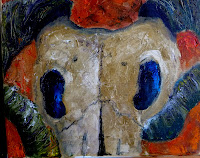


When I got them out to show Tony there was a barely disguised sigh and a suggestion that I put them away as they weren't leading anywhere. He's probably right although I was not wholly unhappy with what they indicated. The middle more abstract painting included a sculpted piece of polymer clay which was another idea for a possible direction.
What did catch his eye were a series of very loose water colour studies that I had done the week before and which did, I agree, seem more promising:


 These were water colour washes, with pen and ink and in some cases wax pastels. I genuinely hadn't a clue what I was trying to achieve and as a result, I suspect, actually created some images that had potential.
These caused us to talk about what I was trying to do. His main critique was that most of what I did was too governed by outcome. I was 'end gaming': trying to achieve something that I thought other people would
think looked good, rather than genuinely exploring. "The trouble with spending a lot of time trying to draw a bone is that all you can really say about it is: yes it looks like a bone (or not)." What we should be looking for are images that are more malleable: they suggest bone, but they suggest more and as a viewer you can take the image for a walk, it offers some alternative journeys. I found this very helpful. I certainly need to to find ways to let myself go and to eliminate, at this stage at least, a concern for what will look good in the sketch book or for achieving a satisfying effect that is actually nothing much more than just that. Helpful but not easy!
In subsequent conversations with my partner and son both suggested that a way forward was to find ways to put myself into the process. To find ways to connect my own lived experience with the art I am producing. There is a danger that it becomes a cliche: the lurch for the autobiographical. However, one direction this advice did suggest was to find ways to look at my own bones and as luck(!) would have it I recently dislocated my finger and had my hand X rayed. It is not a pretty sight, but it might give me a new avenue to explore: it not only connects with some lived experience but it also opens up another possibility (suggested by Ben) of exploring 'layers' of perception.


When I got them out to show Tony there was a barely disguised sigh and a suggestion that I put them away as they weren't leading anywhere. He's probably right although I was not wholly unhappy with what they indicated. The middle more abstract painting included a sculpted piece of polymer clay which was another idea for a possible direction.
What did catch his eye were a series of very loose water colour studies that I had done the week before and which did, I agree, seem more promising:


These caused us to talk about what I was trying to do. His main critique was that most of what I did was too governed by outcome. I was 'end gaming': trying to achieve something that I thought other people would
think looked good, rather than genuinely exploring. "The trouble with spending a lot of time trying to draw a bone is that all you can really say about it is: yes it looks like a bone (or not)." What we should be looking for are images that are more malleable: they suggest bone, but they suggest more and as a viewer you can take the image for a walk, it offers some alternative journeys. I found this very helpful. I certainly need to to find ways to let myself go and to eliminate, at this stage at least, a concern for what will look good in the sketch book or for achieving a satisfying effect that is actually nothing much more than just that. Helpful but not easy!
In subsequent conversations with my partner and son both suggested that a way forward was to find ways to put myself into the process. To find ways to connect my own lived experience with the art I am producing. There is a danger that it becomes a cliche: the lurch for the autobiographical. However, one direction this advice did suggest was to find ways to look at my own bones and as luck(!) would have it I recently dislocated my finger and had my hand X rayed. It is not a pretty sight, but it might give me a new avenue to explore: it not only connects with some lived experience but it also opens up another possibility (suggested by Ben) of exploring 'layers' of perception.
Monday, 31 October 2011
Portrait progress!
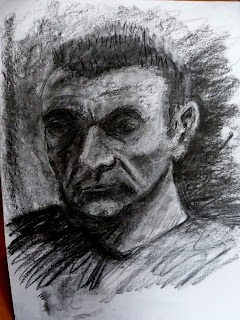
Had a much better session with James Lloyd. I asked for help! A bit of a shock to both of us. He was supportive and got me to realize the tyranny of the line in portrait drawing: there are people who can use line with real impact, but those are people who can draw. James made it clear that it was my detail and line that was holding my drawings back. What I needed to do was to concentrate on form and the best way to do that was to concentrate on light and shade. So a couple of much more convincing efforts (still looking a bit embarrassing on the wall for the crit at the end). Both heads have some body and depth. Only I will know the degree to which I had captured a likeness: truth is not much, but there are aspects that match and the over all impression is so much more convincing. Still got a mountain to climb, but in the foothills at least:


Thursday, 27 October 2011
Jerwood Drawing prize. Liz Bailey's bonzai tree
Went to the Jerwood Drawing Prize exhibition. On my own as away in Bangkok for the course trip. Plenty to talk about not least the incredible range of what passes for 'drawing'. Most showed a wonderful command of the medium, but others seem to be challenging the whole notion of a drawing. The winners were, strangely given the range, very traditional drawings on a grand scale. Both displayed incredible skill and a similar degree of whimsy in the subject matter.
One drawing had special resonance as I had visited the artist, Liz Bailey's studio while she was int he middle of the drawing.In the exhibition you saw a gloriously detailed drawing of a tree some two metres in height. What is not clear is that she has scaled this up from a dead bonsai tree approximately 6" high. An inspiring feat of close observation drawing and very beautiful as well.
Here is the tree and the drawing. the tree was suspended with nylon fishing line.
 Here is the tree:
 An here are the pencil sharpenings that she carefully collected by the drawing!

One drawing had special resonance as I had visited the artist, Liz Bailey's studio while she was int he middle of the drawing.In the exhibition you saw a gloriously detailed drawing of a tree some two metres in height. What is not clear is that she has scaled this up from a dead bonsai tree approximately 6" high. An inspiring feat of close observation drawing and very beautiful as well.
Here is the tree and the drawing. the tree was suspended with nylon fishing line.


Sunday, 9 October 2011
Portrait pain!
Completed the first three weeks of Drawing the Head with James Lloyd at the Princes' Drawing School. I knew this was going to be challenging and was braced to have my technical skills cruelly exposed. I was on the other hand hoping for some guidance and even some real teaching. But, so far, that is not the way it is. For a start it is essentially a group of people all of whom seem to have had a lot of experience and seem to be regular attenders. There is a knowing air about the place, no room for my clumsy uncertainty. James is pleasant but he clearly takes a pride in not being an interventionist. He devotes much of his time to those who are clearly on top of the task: it is a discourse that both he and they sound comfortable with and feels a long way from where I am.
My first efforts were crude and lacking in any signs of control or interpretation. Just a desperate attempt to achieve approximate proportion and a strive for the endless number of nuances that make up a distinctive head.

It has to be said that one of the disadvantages of not being an old hand was that I got there too late to get a decent angle on the model. The harsh profile did not help me. But then the worst part was the crit at the end where we were asked to put up our drawings on the wall. I was pretty unhappy with my efforts by my own criteria, but the humiliation of having it sticking out like a septic thumb amongst a variety of delicate and stylish efforts was more than I could bear. Worst was watching James moving across the collection and doing a brief intake of breath followed by delicate shimmy to get past mine without comment!
The next week was not a lot better but at least I had a better angle to work with. What I also discovered was that doing one drawing for two hours was actually making things worse. Here is the study after just half an hour:
 The third week continued to be a battle. I was determined to loosen up, to use charcoal in a more expressive way and not get bogged down in details (mouths. . ugh!). The end result was, I think and hope better although it seems to me to lack character: too much close observation (not very accurate) and not enough interpretation.
 A week off while I go to Bangkok. Then back to it in the hope that there will be a little more teaching on offer, but I suspect in the context of this group, I am beyond the easy discourse of the competent.
My first efforts were crude and lacking in any signs of control or interpretation. Just a desperate attempt to achieve approximate proportion and a strive for the endless number of nuances that make up a distinctive head.

It has to be said that one of the disadvantages of not being an old hand was that I got there too late to get a decent angle on the model. The harsh profile did not help me. But then the worst part was the crit at the end where we were asked to put up our drawings on the wall. I was pretty unhappy with my efforts by my own criteria, but the humiliation of having it sticking out like a septic thumb amongst a variety of delicate and stylish efforts was more than I could bear. Worst was watching James moving across the collection and doing a brief intake of breath followed by delicate shimmy to get past mine without comment!
The next week was not a lot better but at least I had a better angle to work with. What I also discovered was that doing one drawing for two hours was actually making things worse. Here is the study after just half an hour:


At the start: deciding on a way forward
Like most of the group, I have been somewhat uncertain as to how to start off on what will be a ten month journey culminating in our show next July. It is hard to plan a journey when you really have little idea where the first stop might be, leave alone the end destination. My skull development, described in the last post, is clearly a place to start, but after a tutorial with Chris and discussions with others, it all suddenly seems a little predictable and even aimless.
But it was clear I could easily think my way into stasis and after an encouraging chat with my good friend and art mentor Pete Sanders I felt encouraged just to loosen up and try a few things: in particular, some collage. So first session, spent the morning putting together a collage with torn up pieces of cardboard, and one of my first lino cuts. It was satisfying and indeed suggested one way forward. It had a feel of those English abstract landscapes that I admire and aspire to:
 As well as the collage I worked in some detail in pen and colour with oil pastels.
The other direction I have been pursuing has been the very traditional type of research which is merely to do a lot of closely observes pencil and pen drawings of skulls of various kinds. Started at the Hunterian Museum at the Royal College of surgeons, where I spent time on a tiger skull:
 Then took one of the teeth formations and used pastels to develop the landscape idea:
 Later in the week to the Science Museum and Pitt Rivers where I worked on a baby elephant's skull in charcoal and pencil:
 And then the feet structure:

The close observation is always good and also finding the appropriate mark making to render the detail is also valuable. I am trying to focus my attention on fragments, looking for the shapes and the formation that lie below them. In one sense forcing myself to explore the abstract potential.
Back in class I took some of those sketches and went in another stage. Here is a close up study of a filigree segment of the skull:
 Then an attempt to use light and shade in charcoal to isolate another set of shapes.
 I am still not sure where it is leading, but there has been some development around the collage and the detailed observation so I shall continue for a week or two to see how it builds up. In a couple of weeks I am going for a week in Wales, where I am going to follow this work up with a series of colour sketches in oils and pastels.
But it was clear I could easily think my way into stasis and after an encouraging chat with my good friend and art mentor Pete Sanders I felt encouraged just to loosen up and try a few things: in particular, some collage. So first session, spent the morning putting together a collage with torn up pieces of cardboard, and one of my first lino cuts. It was satisfying and indeed suggested one way forward. It had a feel of those English abstract landscapes that I admire and aspire to:

The other direction I have been pursuing has been the very traditional type of research which is merely to do a lot of closely observes pencil and pen drawings of skulls of various kinds. Started at the Hunterian Museum at the Royal College of surgeons, where I spent time on a tiger skull:


The close observation is always good and also finding the appropriate mark making to render the detail is also valuable. I am trying to focus my attention on fragments, looking for the shapes and the formation that lie below them. In one sense forcing myself to explore the abstract potential.
Back in class I took some of those sketches and went in another stage. Here is a close up study of a filigree segment of the skull:


Tuesday, 27 September 2011
From Sheep's Skull to 'a Personal Practice'
The second year of the CLFA is underway and despite the support of fellow course members and the tutors we are 'on our own'. The challenge is to map out a project that will allow us to develop a personal practice and will culminate in our first show in July next year. So where to start?
One of the things that Chris Hough said at the start of the first year was that they wanted us to try and sustain some thematic links between the various aspects of our course. I took this a little more seriously than others especially after a session on sketchbook development (which should have been three but I missed two!). We were asked to take images from our sketch books and try to develop and extend them. I chose a rather mundane sketch I had done of a sheep's skull:
 Then through photocopying it in different sizes and collaging them I came up with a rather pleasing page int he sketchbook:
 There were other versions and it became (as a good sketch book should) a source of ideas for the next stages. So, I took the image into my printmaking and started to think of other ways to develop the theme. I did more sketches of the same skull and then started to photograph it:
 I then started to import those images into Brushes on my iPad and used them as the basis for a series of abstract explorations of colour and shape.

 What I was interested in was the way they started to look like landscapes and indeed Welsh landscapes: the place where the skull came from in the first place.
Just as I was starting to think I had run the course of the idea I went to visit the Henry Moore museum at Perry Green and in one of his workshops I discovered his enormous elephant skull which he had spent two years drawing and etching.
 Of course, anyone who knows anything about Henry Moore knows about the Elephant's Skull drawings, but it came as an encouragement to me. Especially when I started to read what he had said about it:
So I seemed to have some motivation to pursue this rather mundane and I suspect rather well worn path: at least for the time being. Over the summer I took it one stage further and tired to take one of my iPad explorations and turn it into a painting. It is not really finished and is still a little flat: but it suggests that there is some promise here and I shall stick with it.

One of the things that Chris Hough said at the start of the first year was that they wanted us to try and sustain some thematic links between the various aspects of our course. I took this a little more seriously than others especially after a session on sketchbook development (which should have been three but I missed two!). We were asked to take images from our sketch books and try to develop and extend them. I chose a rather mundane sketch I had done of a sheep's skull:


Just as I was starting to think I had run the course of the idea I went to visit the Henry Moore museum at Perry Green and in one of his workshops I discovered his enormous elephant skull which he had spent two years drawing and etching.

“By bringing the skull very close to me and drawing various details I found so many contrasts of form and shape that I could begin to see in it great deserts and rocky landscapes, big caves in the sides of hills, great pieces of architecture, columns and dungeons and so this series of etchings is really a mixture of observation and imagination.”
So I seemed to have some motivation to pursue this rather mundane and I suspect rather well worn path: at least for the time being. Over the summer I took it one stage further and tired to take one of my iPad explorations and turn it into a painting. It is not really finished and is still a little flat: but it suggests that there is some promise here and I shall stick with it.

Monday, 19 September 2011
Overview of Year One CLFA: Final research and drawing
The last four sessions of the course were led by Tony Hull and gave me the best consistent experience of the whole course culminating in the first piece of completed work that I was genuinely pleased with and pointed the way forward for this second year.
Tony wanted us to understand the process of an evolving piece of work based on research. We began, slightly oddly, with some detailed charcoal drawing of the sort that Tony had challenged us with at the beginning of the course. Draw that cube! Should be easy, but of course so much more difficult than you would think to capture the subtleties of perspective which naturally disrupt ones belief in the parallel line!

Then in the afternoon we were to build up our drawing with a series of related cubes exploring the effect of cutting holes in blocks. The end result looked like this:

No particularly inspiring, but another step on the way to careful observed drawing, the demands of perspective and reminding me of the fluidity of charcoal and its residual reminders of the line not taken!
The next session took us off to the Natural History Museum for some close observation of crystals.

Very much enjoyed the day and learn a lot from Tony’s insistence that what we are trying to do with the sketches is an expression of what we are seeing rather than a complete drawing. He urged us not to 'overstrive for the artful'. My initial sketches were quite pleasing, but really didn’t tell me much about what was interesting or striking about a shape, a texture and line. My drawings after lunch were freer and more expressive and as a result eventually gave me more to work with.

The next session (rather bizarrely) was a one off printmaking class with Brian. This seemed to break with the research objectives. Somewhat to his surprise, we were to use our sketches from the NHM as a basis of some prints. I don’t think I was alone in finding the session rather dispiriting: after the enthusiasm and the precision of what we had done in the museum, this all seemed too vague. I felt I went back to square one with my print making: no control and no real inspiration. I produced a couple of of pretty scruffy prints that seemed to lead nowhere.
Then the final session and something of a breakthrough. Back with Tony and a stronger sense of the original purpose. He told us to take the drawing of the cubes and rub it down. (Tony is a great one for rubbing down the charcola drawings and starting again on the patina of the old). This was to be the basis of our final piece of work. Then we were to tear up one of our prints from last session and locate one or two fragments on the drawing. This fragment was to be the starting point for a piece of exploratory drawing: extending and pushing the visual ideas we had collected in the museum. It seemed like a long shot. All of us were bemused and there were a lot of false starts, but for some reason, it suddenly made sense to me and I took off on what I think was the most successful piece of art of the whole course. I was engaged in mark making and shape finding: one thing lead to another and piece took off across the page. The fragment added counter point. I had begun with several pieces, but in the end it was a couple of small fragments that worked best. Less, as is so often the case, is more.

I had the drawing done in under two hours. It seemed to flow in a way that nothing else on the course had. It had traces of my original crystal study and of my skull work. It was very satisfying. I am not at all sure that the cubes add anything much to the picture except there is a certain contrast between the random organic shape and the ordered structure of the cubes, but I am not sure.
With some time to spare and a heavy coating of charcoal, someone suggested that I should try making a print off it. The result was almost more interesting than the original and again suggested another perhaps more organic approach to printmaking.

It was a very satisfying end to the first year and left me with some hope for the second year and the challenge of 'developing my personal practice'.
Subscribe to:
Posts (Atom)