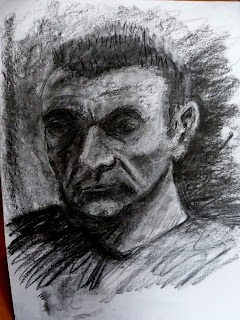
Had a much better session with James Lloyd. I asked for help! A bit of a shock to both of us. He was supportive and got me to realize the tyranny of the line in portrait drawing: there are people who can use line with real impact, but those are people who can draw. James made it clear that it was my detail and line that was holding my drawings back. What I needed to do was to concentrate on form and the best way to do that was to concentrate on light and shade. So a couple of much more convincing efforts (still looking a bit embarrassing on the wall for the crit at the end). Both heads have some body and depth. Only I will know the degree to which I had captured a likeness: truth is not much, but there are aspects that match and the over all impression is so much more convincing. Still got a mountain to climb, but in the foothills at least:
A record of the sometimes painful process of turning myself into something like a practicing artist after fifteen years of evening classes. A two year journey accompanied by my fellow travellers and the tutors on the City Lit Fine Art course 2010-12.
Monday, 31 October 2011
Thursday, 27 October 2011
Jerwood Drawing prize. Liz Bailey's bonzai tree
Went to the Jerwood Drawing Prize exhibition. On my own as away in Bangkok for the course trip. Plenty to talk about not least the incredible range of what passes for 'drawing'. Most showed a wonderful command of the medium, but others seem to be challenging the whole notion of a drawing. The winners were, strangely given the range, very traditional drawings on a grand scale. Both displayed incredible skill and a similar degree of whimsy in the subject matter.
One drawing had special resonance as I had visited the artist, Liz Bailey's studio while she was int he middle of the drawing.In the exhibition you saw a gloriously detailed drawing of a tree some two metres in height. What is not clear is that she has scaled this up from a dead bonsai tree approximately 6" high. An inspiring feat of close observation drawing and very beautiful as well.
Here is the tree and the drawing. the tree was suspended with nylon fishing line.
Here is the tree:
An here are the pencil sharpenings that she carefully collected by the drawing!
One drawing had special resonance as I had visited the artist, Liz Bailey's studio while she was int he middle of the drawing.In the exhibition you saw a gloriously detailed drawing of a tree some two metres in height. What is not clear is that she has scaled this up from a dead bonsai tree approximately 6" high. An inspiring feat of close observation drawing and very beautiful as well.
Here is the tree and the drawing. the tree was suspended with nylon fishing line.
Here is the tree:
An here are the pencil sharpenings that she carefully collected by the drawing!
Sunday, 9 October 2011
Portrait pain!
Completed the first three weeks of Drawing the Head with James Lloyd at the Princes' Drawing School. I knew this was going to be challenging and was braced to have my technical skills cruelly exposed. I was on the other hand hoping for some guidance and even some real teaching. But, so far, that is not the way it is. For a start it is essentially a group of people all of whom seem to have had a lot of experience and seem to be regular attenders. There is a knowing air about the place, no room for my clumsy uncertainty. James is pleasant but he clearly takes a pride in not being an interventionist. He devotes much of his time to those who are clearly on top of the task: it is a discourse that both he and they sound comfortable with and feels a long way from where I am.
My first efforts were crude and lacking in any signs of control or interpretation. Just a desperate attempt to achieve approximate proportion and a strive for the endless number of nuances that make up a distinctive head.
It has to be said that one of the disadvantages of not being an old hand was that I got there too late to get a decent angle on the model. The harsh profile did not help me. But then the worst part was the crit at the end where we were asked to put up our drawings on the wall. I was pretty unhappy with my efforts by my own criteria, but the humiliation of having it sticking out like a septic thumb amongst a variety of delicate and stylish efforts was more than I could bear. Worst was watching James moving across the collection and doing a brief intake of breath followed by delicate shimmy to get past mine without comment!
The next week was not a lot better but at least I had a better angle to work with. What I also discovered was that doing one drawing for two hours was actually making things worse. Here is the study after just half an hour:
The third week continued to be a battle. I was determined to loosen up, to use charcoal in a more expressive way and not get bogged down in details (mouths. . ugh!). The end result was, I think and hope better although it seems to me to lack character: too much close observation (not very accurate) and not enough interpretation.
A week off while I go to Bangkok. Then back to it in the hope that there will be a little more teaching on offer, but I suspect in the context of this group, I am beyond the easy discourse of the competent.
My first efforts were crude and lacking in any signs of control or interpretation. Just a desperate attempt to achieve approximate proportion and a strive for the endless number of nuances that make up a distinctive head.
It has to be said that one of the disadvantages of not being an old hand was that I got there too late to get a decent angle on the model. The harsh profile did not help me. But then the worst part was the crit at the end where we were asked to put up our drawings on the wall. I was pretty unhappy with my efforts by my own criteria, but the humiliation of having it sticking out like a septic thumb amongst a variety of delicate and stylish efforts was more than I could bear. Worst was watching James moving across the collection and doing a brief intake of breath followed by delicate shimmy to get past mine without comment!
The next week was not a lot better but at least I had a better angle to work with. What I also discovered was that doing one drawing for two hours was actually making things worse. Here is the study after just half an hour:
The third week continued to be a battle. I was determined to loosen up, to use charcoal in a more expressive way and not get bogged down in details (mouths. . ugh!). The end result was, I think and hope better although it seems to me to lack character: too much close observation (not very accurate) and not enough interpretation.
A week off while I go to Bangkok. Then back to it in the hope that there will be a little more teaching on offer, but I suspect in the context of this group, I am beyond the easy discourse of the competent.
At the start: deciding on a way forward
Like most of the group, I have been somewhat uncertain as to how to start off on what will be a ten month journey culminating in our show next July. It is hard to plan a journey when you really have little idea where the first stop might be, leave alone the end destination. My skull development, described in the last post, is clearly a place to start, but after a tutorial with Chris and discussions with others, it all suddenly seems a little predictable and even aimless.
But it was clear I could easily think my way into stasis and after an encouraging chat with my good friend and art mentor Pete Sanders I felt encouraged just to loosen up and try a few things: in particular, some collage. So first session, spent the morning putting together a collage with torn up pieces of cardboard, and one of my first lino cuts. It was satisfying and indeed suggested one way forward. It had a feel of those English abstract landscapes that I admire and aspire to:
As well as the collage I worked in some detail in pen and colour with oil pastels.
The other direction I have been pursuing has been the very traditional type of research which is merely to do a lot of closely observes pencil and pen drawings of skulls of various kinds. Started at the Hunterian Museum at the Royal College of surgeons, where I spent time on a tiger skull:
Then took one of the teeth formations and used pastels to develop the landscape idea:
Later in the week to the Science Museum and Pitt Rivers where I worked on a baby elephant's skull in charcoal and pencil:
And then the feet structure:
The close observation is always good and also finding the appropriate mark making to render the detail is also valuable. I am trying to focus my attention on fragments, looking for the shapes and the formation that lie below them. In one sense forcing myself to explore the abstract potential.
Back in class I took some of those sketches and went in another stage. Here is a close up study of a filigree segment of the skull:
Then an attempt to use light and shade in charcoal to isolate another set of shapes.
I am still not sure where it is leading, but there has been some development around the collage and the detailed observation so I shall continue for a week or two to see how it builds up. In a couple of weeks I am going for a week in Wales, where I am going to follow this work up with a series of colour sketches in oils and pastels.
But it was clear I could easily think my way into stasis and after an encouraging chat with my good friend and art mentor Pete Sanders I felt encouraged just to loosen up and try a few things: in particular, some collage. So first session, spent the morning putting together a collage with torn up pieces of cardboard, and one of my first lino cuts. It was satisfying and indeed suggested one way forward. It had a feel of those English abstract landscapes that I admire and aspire to:
As well as the collage I worked in some detail in pen and colour with oil pastels.
The other direction I have been pursuing has been the very traditional type of research which is merely to do a lot of closely observes pencil and pen drawings of skulls of various kinds. Started at the Hunterian Museum at the Royal College of surgeons, where I spent time on a tiger skull:
Then took one of the teeth formations and used pastels to develop the landscape idea:
Later in the week to the Science Museum and Pitt Rivers where I worked on a baby elephant's skull in charcoal and pencil:
And then the feet structure:
The close observation is always good and also finding the appropriate mark making to render the detail is also valuable. I am trying to focus my attention on fragments, looking for the shapes and the formation that lie below them. In one sense forcing myself to explore the abstract potential.
Back in class I took some of those sketches and went in another stage. Here is a close up study of a filigree segment of the skull:
Then an attempt to use light and shade in charcoal to isolate another set of shapes.
I am still not sure where it is leading, but there has been some development around the collage and the detailed observation so I shall continue for a week or two to see how it builds up. In a couple of weeks I am going for a week in Wales, where I am going to follow this work up with a series of colour sketches in oils and pastels.
Tuesday, 27 September 2011
From Sheep's Skull to 'a Personal Practice'
The second year of the CLFA is underway and despite the support of fellow course members and the tutors we are 'on our own'. The challenge is to map out a project that will allow us to develop a personal practice and will culminate in our first show in July next year. So where to start?
One of the things that Chris Hough said at the start of the first year was that they wanted us to try and sustain some thematic links between the various aspects of our course. I took this a little more seriously than others especially after a session on sketchbook development (which should have been three but I missed two!). We were asked to take images from our sketch books and try to develop and extend them. I chose a rather mundane sketch I had done of a sheep's skull:
Then through photocopying it in different sizes and collaging them I came up with a rather pleasing page int he sketchbook:
There were other versions and it became (as a good sketch book should) a source of ideas for the next stages. So, I took the image into my printmaking and started to think of other ways to develop the theme. I did more sketches of the same skull and then started to photograph it:
I then started to import those images into Brushes on my iPad and used them as the basis for a series of abstract explorations of colour and shape.
What I was interested in was the way they started to look like landscapes and indeed Welsh landscapes: the place where the skull came from in the first place.
Just as I was starting to think I had run the course of the idea I went to visit the Henry Moore museum at Perry Green and in one of his workshops I discovered his enormous elephant skull which he had spent two years drawing and etching.
Of course, anyone who knows anything about Henry Moore knows about the Elephant's Skull drawings, but it came as an encouragement to me. Especially when I started to read what he had said about it:
So I seemed to have some motivation to pursue this rather mundane and I suspect rather well worn path: at least for the time being. Over the summer I took it one stage further and tired to take one of my iPad explorations and turn it into a painting. It is not really finished and is still a little flat: but it suggests that there is some promise here and I shall stick with it.
One of the things that Chris Hough said at the start of the first year was that they wanted us to try and sustain some thematic links between the various aspects of our course. I took this a little more seriously than others especially after a session on sketchbook development (which should have been three but I missed two!). We were asked to take images from our sketch books and try to develop and extend them. I chose a rather mundane sketch I had done of a sheep's skull:
Then through photocopying it in different sizes and collaging them I came up with a rather pleasing page int he sketchbook:
There were other versions and it became (as a good sketch book should) a source of ideas for the next stages. So, I took the image into my printmaking and started to think of other ways to develop the theme. I did more sketches of the same skull and then started to photograph it:
I then started to import those images into Brushes on my iPad and used them as the basis for a series of abstract explorations of colour and shape.
What I was interested in was the way they started to look like landscapes and indeed Welsh landscapes: the place where the skull came from in the first place.
Just as I was starting to think I had run the course of the idea I went to visit the Henry Moore museum at Perry Green and in one of his workshops I discovered his enormous elephant skull which he had spent two years drawing and etching.
Of course, anyone who knows anything about Henry Moore knows about the Elephant's Skull drawings, but it came as an encouragement to me. Especially when I started to read what he had said about it:
“By bringing the skull very close to me and drawing various details I found so many contrasts of form and shape that I could begin to see in it great deserts and rocky landscapes, big caves in the sides of hills, great pieces of architecture, columns and dungeons and so this series of etchings is really a mixture of observation and imagination.”
So I seemed to have some motivation to pursue this rather mundane and I suspect rather well worn path: at least for the time being. Over the summer I took it one stage further and tired to take one of my iPad explorations and turn it into a painting. It is not really finished and is still a little flat: but it suggests that there is some promise here and I shall stick with it.
Monday, 19 September 2011
Overview of Year One CLFA: Final research and drawing
The last four sessions of the course were led by Tony Hull and gave me the best consistent experience of the whole course culminating in the first piece of completed work that I was genuinely pleased with and pointed the way forward for this second year.
Tony wanted us to understand the process of an evolving piece of work based on research. We began, slightly oddly, with some detailed charcoal drawing of the sort that Tony had challenged us with at the beginning of the course. Draw that cube! Should be easy, but of course so much more difficult than you would think to capture the subtleties of perspective which naturally disrupt ones belief in the parallel line!
Then in the afternoon we were to build up our drawing with a series of related cubes exploring the effect of cutting holes in blocks. The end result looked like this:
No particularly inspiring, but another step on the way to careful observed drawing, the demands of perspective and reminding me of the fluidity of charcoal and its residual reminders of the line not taken!
The next session took us off to the Natural History Museum for some close observation of crystals.
Very much enjoyed the day and learn a lot from Tony’s insistence that what we are trying to do with the sketches is an expression of what we are seeing rather than a complete drawing. He urged us not to 'overstrive for the artful'. My initial sketches were quite pleasing, but really didn’t tell me much about what was interesting or striking about a shape, a texture and line. My drawings after lunch were freer and more expressive and as a result eventually gave me more to work with.
The next session (rather bizarrely) was a one off printmaking class with Brian. This seemed to break with the research objectives. Somewhat to his surprise, we were to use our sketches from the NHM as a basis of some prints. I don’t think I was alone in finding the session rather dispiriting: after the enthusiasm and the precision of what we had done in the museum, this all seemed too vague. I felt I went back to square one with my print making: no control and no real inspiration. I produced a couple of of pretty scruffy prints that seemed to lead nowhere.
Then the final session and something of a breakthrough. Back with Tony and a stronger sense of the original purpose. He told us to take the drawing of the cubes and rub it down. (Tony is a great one for rubbing down the charcola drawings and starting again on the patina of the old). This was to be the basis of our final piece of work. Then we were to tear up one of our prints from last session and locate one or two fragments on the drawing. This fragment was to be the starting point for a piece of exploratory drawing: extending and pushing the visual ideas we had collected in the museum. It seemed like a long shot. All of us were bemused and there were a lot of false starts, but for some reason, it suddenly made sense to me and I took off on what I think was the most successful piece of art of the whole course. I was engaged in mark making and shape finding: one thing lead to another and piece took off across the page. The fragment added counter point. I had begun with several pieces, but in the end it was a couple of small fragments that worked best. Less, as is so often the case, is more.
I had the drawing done in under two hours. It seemed to flow in a way that nothing else on the course had. It had traces of my original crystal study and of my skull work. It was very satisfying. I am not at all sure that the cubes add anything much to the picture except there is a certain contrast between the random organic shape and the ordered structure of the cubes, but I am not sure.
With some time to spare and a heavy coating of charcoal, someone suggested that I should try making a print off it. The result was almost more interesting than the original and again suggested another perhaps more organic approach to printmaking.
It was a very satisfying end to the first year and left me with some hope for the second year and the challenge of 'developing my personal practice'.
Sketchbook and Galleries course
In the summer term I did an extra course with Lucinda Oestreicher in which she took us around a series of galleries in the East End. She was also encouraging us to use our sketchbooks both as record of what we had seen and as a way of getting us to look closely. As ever my American trips meant I only did three out of five, but those I did do were very simulating. She is a genuinely good teacher: opening your eyes and pushing you a bit.
I was really pleased to have this intro into the art world: there are literally hundreds of small galleries featuring the work of one or two artists. As well as being aesthetically challenging it also started me thinking about the business of art. About artists developing their work and their intellectual positioning in a coherent fashion so that it holds together in an exhibition and attracts the interest of collectors.
I also started to use my sketch book in a more creative way, even though my poor drawing and recording skills made for some pretty uninspiring pages. The point however, is that I do have some sort of a record of works that interested me. I have started to take a sketchbook to galleries now and try always to represent at least a few bits of work and even the ideas that they generate. Obvious, I know, but all part of the slow evolution of a personal practice. Painful and slow, but progress nevertheless.
Some of the galleries we visited include
Herald St The Approach
Carter Presents Wilkinson
Vilma Gold Arch 402
Herald St The Approach
Carter Presents Wilkinson
Vilma Gold Arch 402
Subscribe to:
Posts (Atom)


