For my second attempt at an animation piece I have brought in the sculpted bones and worked up a short piece that tries to link the bones and the hand. There are a few (gratuitous?) special effects to emphasise the transitions. I have also added a little low key music.
Although I get some satisfaction from the superficial appeal of this short piece, it has rather made me wonder whether this is a productive direction to go in. I feel it is a little too obvious and 'on the nose' as a script writer may say. I am not sure whether this is a medium that will allow for a 'malleable' piece of art. Perhaps I am fighting the film maker in me again.
I will persevere with a few more ideas and then perhaps think about how I could pull them together in a single piece. Nevertheless I can only explore this work in my own time with the copy stand at home, and I find I am rather daunted by the prospect of another day in our rather cramped studio as I am very unsure where to take my 2D work.
Monday, 16 January 2012


Friday, 13 January 2012
Animation Part 1: my drawing hand
During the first year my nephew Jesse Ash , an accomplished artist and art theorist, introduced me to the work of William Kentridge, the South African artist who spent some time working on sustained animated charcoal drawings. Jesse felt that it combined my enthusiasm for charcoal drawings (that had been instilled largely by Tony Hull's first session on this course) with my background as a film maker. I have been resisting any connection with that part of my creative experience on the grounds that I was not much taken by video art and I felt that my professional sensibilities would get in the way of anything authentic in the way of art. However, the Kentridge videos did get me excited and I had always intended to give it a try.
Following my investment in my hand, its injuries, its bones and, I suppose, its eventual mortality: I thought that I wanted to explore the role my hand plays in my art in general and then, in particular, its role in my struggle to draw and make art. So, it seemed that a charcoal animation might be the way to develop this idea.
I knew enough about the process to know that it is very hard to do without at least some sort of solid stand and lighting and to my intense surprise, I found myself locating and buying a professional copy stand on Ebay, closing the deal on a very reasonable £75. I decided that I was going to restrict myself to still images on a stills camera, rather than use a video camera. These images would be edited in a very basic Microsoft editing programme Windows Live Movie Maker.
This was my first effort:
The wooden hand was one of those artist models that I had been using to help me draw: (actually they don't help much as they don't really resemble a human hand at all, more the hand of rather poorly constructed robot!).The struggle to draw it was all mine! I resisted the temptation to 'tidy it up', it felt like the odd appearance of the drawing hand itself had a useful foregrounding effect. It does not look like the work of a film maker, and that feels right at this stage.
Following my investment in my hand, its injuries, its bones and, I suppose, its eventual mortality: I thought that I wanted to explore the role my hand plays in my art in general and then, in particular, its role in my struggle to draw and make art. So, it seemed that a charcoal animation might be the way to develop this idea.
I knew enough about the process to know that it is very hard to do without at least some sort of solid stand and lighting and to my intense surprise, I found myself locating and buying a professional copy stand on Ebay, closing the deal on a very reasonable £75. I decided that I was going to restrict myself to still images on a stills camera, rather than use a video camera. These images would be edited in a very basic Microsoft editing programme Windows Live Movie Maker.
This was my first effort:
The wooden hand was one of those artist models that I had been using to help me draw: (actually they don't help much as they don't really resemble a human hand at all, more the hand of rather poorly constructed robot!).The struggle to draw it was all mine! I resisted the temptation to 'tidy it up', it felt like the odd appearance of the drawing hand itself had a useful foregrounding effect. It does not look like the work of a film maker, and that feels right at this stage.
Sculpted bones
To my surprise the next step in exploring the bones in my hand was to start sculpting them out of polymer clay. It was chance activity, I had the clay for another purpose entirely (making prints), but stuck for something to do in the studio session. They results were surprisingly satisfying. Initially I was concentrating on representing my dislocated finger:

Then I thought I would link the sculpted bones to the still swollen finger. It was strangely disturbing process. To have such a strong reminder of what had happened to the actual bones gave me a strangely physical jolt.
 When I showed this image to Tony he was very struck by its potency which surprised me as I felt there was little meaning aside of my own very personal reaction. It caused me to think more about the development of really personal art. Thinking of Tracy Emin and her personal fragments that only resonate in the context of her particular history.
I decided to pursue the idea of sculpting the bones in my hand and although I only had a limited amount of clay which meant that I could not maintain a consistent colour, I did make all the bones in my right hand. Once pieced together they created another promising image:


Then I thought I would link the sculpted bones to the still swollen finger. It was strangely disturbing process. To have such a strong reminder of what had happened to the actual bones gave me a strangely physical jolt.

I decided to pursue the idea of sculpting the bones in my hand and although I only had a limited amount of clay which meant that I could not maintain a consistent colour, I did make all the bones in my right hand. Once pieced together they created another promising image:

Tuesday, 13 December 2011
That dislocated finger
In the November 14th post I write about how I was pushing myself (and being pushed) towards a more personal engagement with the work I had been doing on the skull and bones. It has proved a fruitful development and it all began with that dislocated finger. Whilst in Thailand I slipped on the side of a swimming pool and dislocated my finger in an alarming way. I was taken to the local hospital where they took an X ray which I was allowed to keep:

I wanted to find ways to represent that view of my hand and its injury and thought about some of efforts to describe the bone shapes by rubbing into a charcoal field. It seemed an ideal way to capture the X ray effect, so I drew an X ray of my hand:

I then started to work on that charcoal drawing with a series of watercolour washes to try and show the way an X ray has a ghostly shadow of your flesh and skin. The colour was not not really right, but the image did go some way to recording my experience and indeed the discomfort: and to reinforce the connection I added a fragment from the envelope that was presented to me by the Thai doctor:


I wanted to find ways to represent that view of my hand and its injury and thought about some of efforts to describe the bone shapes by rubbing into a charcoal field. It seemed an ideal way to capture the X ray effect, so I drew an X ray of my hand:

I then started to work on that charcoal drawing with a series of watercolour washes to try and show the way an X ray has a ghostly shadow of your flesh and skin. The colour was not not really right, but the image did go some way to recording my experience and indeed the discomfort: and to reinforce the connection I added a fragment from the envelope that was presented to me by the Thai doctor:

The last stages of bone and skull
Before moving onto my new developments around the hand, the impetus for which I wrote about in my last post, I wanted to record the last few pieces of work I completed on the skull theme. I was feeling rather aimless and seemed to be seeing the skull work as a bit of a dead-end. However, looking back I now feel that there was some interesting developments in that work and I don't want to lose track of it.
I had been pleased with some of my experimentation with a range of media on one piece: it was something that had struck me about Henry Moore's drawings in the underground and indeed of the elephant skull. he layered a range of media: pencil, pastel, pen and ink and wash. At the same time, several people had reminded me of Georgia Okeeffe's paintings of landscapes based on a skull. So, in the rather cramped circumstances of our art room (a circumstance which has indeed rather cramped my ambitions) I created a layered skull drawing which was pleasing in the way it suggested some of the rich texture of the skulls I have been looking at:


I then started to work with my soft pastels in a more expressive way. Still looking for a way to turn my skull studies into landscape. A couple of these suggested that this too was not worth abandoning totally.


Finally, I brought all this together with a longer and considered piece based on the skull that used soft pastel on rough watercolour paper, as well as a strong black ink wash to provide a contrasting background. Of course, it would not excite Tony, falling as it does at the hurdle of 'meaning' or 'malleability', but I want to allow myself at least some satisfaction in producing something that has some of the ambiguity around landscape and mortality and is, I think, pleasing on the eye. It seems like a fitting end to a sequence of work that may be little more than a staging post for where I will eventually go with this, but still has some value in its own right.

I had been pleased with some of my experimentation with a range of media on one piece: it was something that had struck me about Henry Moore's drawings in the underground and indeed of the elephant skull. he layered a range of media: pencil, pastel, pen and ink and wash. At the same time, several people had reminded me of Georgia Okeeffe's paintings of landscapes based on a skull. So, in the rather cramped circumstances of our art room (a circumstance which has indeed rather cramped my ambitions) I created a layered skull drawing which was pleasing in the way it suggested some of the rich texture of the skulls I have been looking at:


I then started to work with my soft pastels in a more expressive way. Still looking for a way to turn my skull studies into landscape. A couple of these suggested that this too was not worth abandoning totally.


Finally, I brought all this together with a longer and considered piece based on the skull that used soft pastel on rough watercolour paper, as well as a strong black ink wash to provide a contrasting background. Of course, it would not excite Tony, falling as it does at the hurdle of 'meaning' or 'malleability', but I want to allow myself at least some satisfaction in producing something that has some of the ambiguity around landscape and mortality and is, I think, pleasing on the eye. It seems like a fitting end to a sequence of work that may be little more than a staging post for where I will eventually go with this, but still has some value in its own right.

Monday, 14 November 2011
Another tentative step forward in drawing the head
I had also missed two session of James Lloyd's 'Drawing the Head' course at the Princes' Drawing School. I was assuming that what small steps I had made in my last session would all have washed away, but to my surprise, I was a little more confident and had clearly internalized those lessons about form through light and shade.Two portraits in one evening. Still not a strong likeness but a sense of form and depth. Satisfying, although no cause for complacency!


The trouble with 'end gaming'.
I have missed a couple of sessions of the CLFA course and despite some attempts to explore ideas whilst in Wales, I am still feeling that I am wallowing around somewhat without any clear sense of where I am going. I had a bracing tutorial with Tony Hull which was at once dispiriting and encouraging. I had made an effort in my sketchbook to structure my work so far and although he was polite about my various sketches it was clear that in his eyes they were not leading anywhere worthwhile. Certainly not in the direction I had tentatively explored while in Wales with three small paintings in acrylic: each trying to extend my sketches into colour:
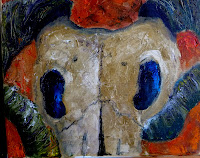


When I got them out to show Tony there was a barely disguised sigh and a suggestion that I put them away as they weren't leading anywhere. He's probably right although I was not wholly unhappy with what they indicated. The middle more abstract painting included a sculpted piece of polymer clay which was another idea for a possible direction.
What did catch his eye were a series of very loose water colour studies that I had done the week before and which did, I agree, seem more promising:


 These were water colour washes, with pen and ink and in some cases wax pastels. I genuinely hadn't a clue what I was trying to achieve and as a result, I suspect, actually created some images that had potential.
These caused us to talk about what I was trying to do. His main critique was that most of what I did was too governed by outcome. I was 'end gaming': trying to achieve something that I thought other people would
think looked good, rather than genuinely exploring. "The trouble with spending a lot of time trying to draw a bone is that all you can really say about it is: yes it looks like a bone (or not)." What we should be looking for are images that are more malleable: they suggest bone, but they suggest more and as a viewer you can take the image for a walk, it offers some alternative journeys. I found this very helpful. I certainly need to to find ways to let myself go and to eliminate, at this stage at least, a concern for what will look good in the sketch book or for achieving a satisfying effect that is actually nothing much more than just that. Helpful but not easy!
In subsequent conversations with my partner and son both suggested that a way forward was to find ways to put myself into the process. To find ways to connect my own lived experience with the art I am producing. There is a danger that it becomes a cliche: the lurch for the autobiographical. However, one direction this advice did suggest was to find ways to look at my own bones and as luck(!) would have it I recently dislocated my finger and had my hand X rayed. It is not a pretty sight, but it might give me a new avenue to explore: it not only connects with some lived experience but it also opens up another possibility (suggested by Ben) of exploring 'layers' of perception.


When I got them out to show Tony there was a barely disguised sigh and a suggestion that I put them away as they weren't leading anywhere. He's probably right although I was not wholly unhappy with what they indicated. The middle more abstract painting included a sculpted piece of polymer clay which was another idea for a possible direction.
What did catch his eye were a series of very loose water colour studies that I had done the week before and which did, I agree, seem more promising:


These caused us to talk about what I was trying to do. His main critique was that most of what I did was too governed by outcome. I was 'end gaming': trying to achieve something that I thought other people would
think looked good, rather than genuinely exploring. "The trouble with spending a lot of time trying to draw a bone is that all you can really say about it is: yes it looks like a bone (or not)." What we should be looking for are images that are more malleable: they suggest bone, but they suggest more and as a viewer you can take the image for a walk, it offers some alternative journeys. I found this very helpful. I certainly need to to find ways to let myself go and to eliminate, at this stage at least, a concern for what will look good in the sketch book or for achieving a satisfying effect that is actually nothing much more than just that. Helpful but not easy!
In subsequent conversations with my partner and son both suggested that a way forward was to find ways to put myself into the process. To find ways to connect my own lived experience with the art I am producing. There is a danger that it becomes a cliche: the lurch for the autobiographical. However, one direction this advice did suggest was to find ways to look at my own bones and as luck(!) would have it I recently dislocated my finger and had my hand X rayed. It is not a pretty sight, but it might give me a new avenue to explore: it not only connects with some lived experience but it also opens up another possibility (suggested by Ben) of exploring 'layers' of perception.
Subscribe to:
Posts (Atom)